Chapter 1: Quantum Foam: The Gateway to the Universe’s Secrets

Updated: Dec 30, 2024
1. Introduction: A New Perspective on Reality
For millennia, humanity has been fascinated by the night sky, pondering the mysteries of the cosmos. Over time, scientific discoveries have revealed much about the universe’s workings—from the laws of gravity that hold planets in orbit to the nuclear reactions that fuel stars. Yet, the deeper we delve into the fabric of reality, the more complex and strange the universe appears, especially at the smallest scales.
At the heart of modern physics lies a concept that challenges our understanding of space and time: quantum foam. This frothy, turbulent structure exists at the Planck scale, the smallest measurable unit of spacetime. But quantum foam is more than just a scientific curiosity. In this series of articles, we will introduce original analogies and ideas to help unravel these difficult concepts, building a new and cohesive perspective of reality.
The analogy we’ll explore is this first article is the idea of quantum foam as a cosmic TV monitor, where its static like frothy behavior static represents the foundational turbulence of spacetime. As we go deeper, we’ll reveal how quantum fields—the patterns that create the universe—are projected onto this cosmic screen, forming the image we know as reality. But first, let’s explore the science behind this analogy.

2. What is Quantum Foam?
To understand quantum foam, we need to begin at the very edge of what physics can currently describe. John Wheeler, a prominent physicist, first proposed the idea of quantum foam in the mid-20th century. He suggested that spacetime is not a smooth, continuous fabric, as we often imagine, but instead behaves like a frothy sea at the smallest scales, known as the Planck scale (about 1.6 × 10⁻³⁵ meters).
At this unimaginably small level, spacetime itself becomes turbulent and chaotic, flickering with constant quantum fluctuations. Particles and energy momentarily pop into and out of existence, creating a bubbling, restless structure. While this quantum foam is impossible to observe directly, it is a theoretical necessity for understanding the most fundamental behavior of spacetime.
Unlike the large-scale structures of galaxies and stars, quantum foam is hidden from our everyday experience. It operates at a level far smaller than the particles that make up atoms, and its effects are only significant at scales so small that they become essentially invisible not only in the macroscopic world but even at the scale of fundamental particles. It is far smaller. Nevertheless, quantum foam is thought to underpin the entire fabric of reality, shaping the space and time in which everything exists.

3. The Cosmic Monitor Analogy
To better grasp the role of quantum foam, we propose an analogy: imagine quantum foam as a cosmic TV monitor, filled with static when no signal is present. The bubbling, frothy nature of spacetime at the Planck scale can be compared to the random static noise on a TV screen. This static is not meaningless; it represents the fundamental “pixels” of spacetime bubbling with energy and potential.
At the Planck scale, spacetime behaves like this static, with quantum fluctuations flickering in and out of existence, much like individual pixels on the screen. The foam creates the underlying structure—the canvas—upon which reality itself is displayed. However, just like a TV screen, the static alone does not create the full picture. Something more is needed to bring order and coherence to this chaotic backdrop. There needs to be a broadcast signal to organize the activity of the individual pixels and form an image on the screen.
This is where quantum fields come into play. If quantum foam is the monitor, quantum fields are the image projected onto it. They give rise to the fundamental particles of matter and energy and provide the structure and the patterns that make the universe intelligible. Let’s explore how quantum fields interact with this foam and bring the cosmos to life.
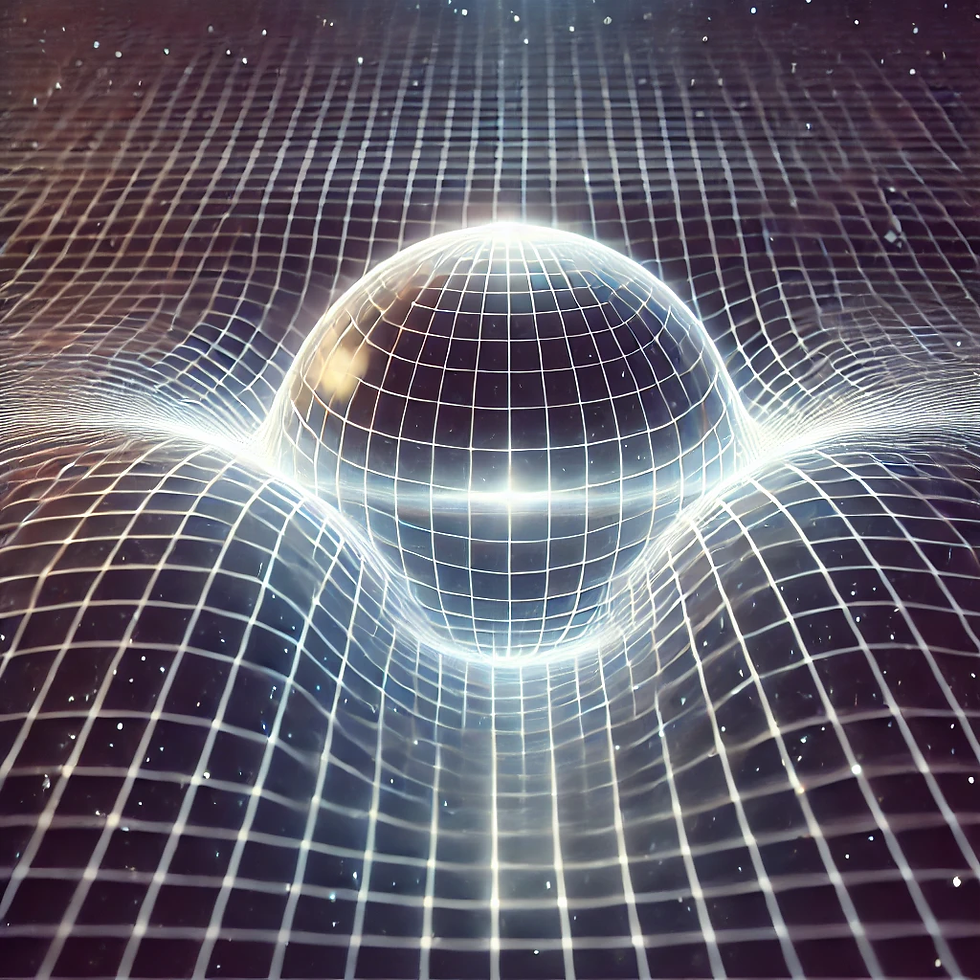
Legend: A fundamental particle represented as a ripple in the quantum field gliding across the staticky background of the quantum foam.
4. Quantum Fields: The Image on the Monitor
Quantum fields are one of the cornerstones of modern physics. According to quantum field theory, everything in the universe—particles, forces, and even empty space—is governed by fields. These fields extend throughout all of spacetime, and particles like electrons or photons are merely excitations of these fields.
In our analogy, quantum fields are the dynamic patterns that appear on the static-filled monitor of quantum foam. They are the energy and forces that modulate the frothy, chaotic quantum foam into the coherent structures we observe: from the fundamental particles that make up matter, which in turn come together to make the stars, planets, and galaxies.
Just as the pixels on a TV screen combine to create a coherent image when a signal is transmitted, the quantum foam provides the resolution necessary for quantum fields to manifest reality. The random static becomes structured when the quantum fields interact with it, giving rise to the intricate dance of particles and waves that glide across the TV Monitor and form the building blocks of the universe.
Without the foam, the quantum fields would have no foundation upon which to display their patterns of energy and matter that make up the universe we experience. The foam, despite its chaotic appearance, serves as the essential medium through which the structured universe can emerge.

5. Implications for Reality
The analogy of quantum foam as a cosmic monitor offers a new way to understand the relationship between the most fundamental elements of spacetime and the observable universe. While quantum foam may seem chaotic and unstructured, it is, in fact, the necessary backdrop for quantum fields to operate and form reality as we know it.
The universe, from this perspective, is not a static, passive entity but a dynamic interplay between the frothy turbulence of quantum foam and the quantum fields that create the structured patterns of energy and matter. Every particle, every force, and every galaxy we observe is a result of this interaction.
This idea also opens up exciting possibilities for understanding our place in the cosmos. We are not merely observers of the universe, but part of the same complex fabric of quantum fields and foam. The same quantum fields that shape the universe at the largest scales also govern the particles within our bodies, connecting us intimately to the very structure of reality.
6. Conclusion: The Gateway to Deeper Understanding
The idea of quantum foam as a cosmic monitor provides a new lens through which to explore the universe. By seeing the foam as the foundational screen and quantum fields as the patterns projected onto it, we gain a clearer understanding of how spacetime, energy, and matter come together to form reality.
However, this is just the beginning. If quantum foam is the monitor, then what more can we learn about the quantum fields that shape the image? These fields govern everything from the smallest particles to the vastest galaxies, and understanding them is key to unlocking the secrets of the universe.
In the next article, Quantum Fields: The Patterns on the Cosmic Monitor, we will dive deeper into the nature of quantum fields themselves—exploring how they form the intricate web of energy and matter that governs the universe. Join me as we uncover how these fields bring coherence to the chaos of quantum foam, shaping the very structure of the cosmos.
References
Quantum Foam: https://en.wikipedia.org/wiki/Quantum_foam
Disclaimer: Speculation at the Edge of Science and Beyond
The vastness of existence extends beyond what is knowable, beyond what is measurable, and far beyond what can be measured with current human technology—inviting us to explore realms that transcend our immediate tools and understanding.
This article explores speculative concepts inspired by scientific ideas, like quantum foam, to invite readers into a deeper reflection on the boundaries of knowledge and the possibilities that lie beyond them. While grounded in established scientific principles where relevant, the focus here is not on what science can measure or prove, but on what might exist at and beyond the edges of the known and knowable.
Science and Its Limits:
Science is among humanity’s most powerful tools for understanding the physical universe, built upon what can be measured, observed, and tested. However, concepts like quantum foam, due to their scale and nature, are beyond our current and foreseeable ability to measure or directly observe. This does not diminish their value as a framework for philosophical or metaphysical reflection. To assume that science is the sole tool for understanding reality is to imply that only the measurable and knowable can exist—a perspective that overlooks the vast opportunities for broader, more imaginative exploration.
Philosophizing Beyond Measurement:
Where science encounters limits, human thought can venture further. Beyond the measurable lies a vast expanse of possibilities that invites us to dream, speculate, and contemplate. These articles lean into the metaphysical, embracing the “what if?” to envision realities that are beyond the reach of our current scientific tools. They encourage readers to consider what might lie beyond the veil of the physical, measurable universe.
A Creative and Metaphysical Exploration:
The purpose of this article is not to assert scientific truths or definitive conclusions but to step beyond the edges of the known, where curiosity meets imagination. It invites readers to dream freely and think unconstrained by the limits of current knowledge, to see the metaphysical as a complement to the scientific—not as a replacement but as another dimension of understanding.
Distinguishing Science from Speculation:
While the ideas presented here draw inspiration from scientific theories, they are firmly speculative and philosophical in nature. They aim to inspire curiosity and contemplation rather than to claim factual accuracy. Readers are encouraged to approach this work as a thought experiment and to distinguish between the speculative reflections herein and the rigorous demands of peer-reviewed science.
An Invitation to Dream:
This article celebrates the interplay between science and imagination, stepping beyond measurement into the realm of possibility. It reflects the belief that there is value in exploring the edges of the physical and metaphysical, where the boundaries blur, and we are free to ask, “What if?”
By venturing into the possible, we honor the limits of our current knowledge while embracing the vastness of what remains unknown and even unknowable. In this way, these explorations are not just about understanding the universe but also about expanding our capacity to dream, imagine, and grow.


Comments