Chapter 3: The Dance of Quantum Fields: Movement Across the Screen

Discover the cosmic dance: how particles emerge as ripples in quantum fields, shaped by the dynamic interplay of quantum foam and quantum fields
Introduction: Building on the Cosmic Monitor Analogy
In the last chapter, we explored quantum fields as the dynamic patterns that emerge on the “cosmic monitor” of reality, projected upon the ever-shifting static of quantum foam. We introduced the idea that the universe’s smallest particles are not self-contained objects, but rather disturbances or excitations within these fields. In this chapter, we take a deeper dive into how quantum fields interact with the backdrop of quantum foam, producing what we observe as movement and change. Much like images dancing across a screen, the movement of particles is not an independent event but the result of underlying field interactions—an emergent phenomenon rather than a direct cause.
In the same way that images appear to glide across a TV screen without the pixels physically moving, particles are part of a grand, interconnected choreography of quantum fields. This chapter will focus on how quantum foam and fields coordinate to create the illusion of movement, offering a new way to understand the fundamental nature of reality and particle interactions.

The Emergence of Movement from Quantum Structures
At first glance, it might seem like particles have their own agency, moving freely from one location to another. But this is an illusion born from our macroscopic view of reality. At the quantum level, the reality is much more fluid. Particles are, in essence, patterns that emerge from the underlying quantum field. They don’t travel—they simply arise, shift, and dissolve based on the evolution of the field in which they are embedded.
This is where the classical notion of movement breaks down. Rather than imagining a particle as a tiny billiard ball rolling across a table, we should think of it more like a ripple in water. The ripple doesn’t move by itself but is part of a larger wave pattern, determined by the interaction between water and the forces acting upon it. The ripple is a manifestation of these forces, just as a particle is a manifestation of the quantum field.

Movement, then, is not a mechanical process but an emergent one. It is the result of changes in the quantum field’s configuration, much like how shifting light patterns on a screen create the illusion of a character running, jumping, or flying. The pixels themselves remain in place; it is their state that changes, creating the appearance of motion.
Quantum Fields and Particle Interactions
To begin, it’s important to grasp a crucial idea from quantum field theory: particles, such as electrons or photons, are not discrete objects moving through space. Rather, they are localized excitations or disturbances in a field that spans the entirety of spacetime. In simpler terms, a particle is a “blip” in an otherwise continuous ocean of energy, a temporary state in a field that exists everywhere at once.
Continuing our TV monitor analogy, imagine an image that seems to move across the screen. What’s actually happening is that different pixels light up and turn off in a sequence, giving the illusion that the image is shifting. The pixels themselves don’t move. Similarly, when we see a particle move from one place to another, we are witnessing the coordinated behavior of a quantum field as it changes state. In the context of our analogy, we are suggesting that the particle doesn’t physically travel; rather, its presence is a momentary expression of the field’s activity.

This concept changes how we think about movement. In the quantum realm, movement isn’t the result of an object relocating itself through space, but the product of shifting patterns within a field. These patterns evolve over time, creating the illusion of movement in the same way that pixels on a screen produce the appearance of motion in a film.
Quantum Field Movement and the Cosmic Dance
With this foundation, we can now understand the metaphor of the “cosmic dance.” The particles and fields we observe are like dancers on a stage, but their movement is not their own. It is choreographed by the quantum fields, which are in turn influenced by the turbulent background of quantum foam.
As with the pixels on a screen, particles don’t move by themselves. Instead, they participate in a coordinated dance where their presence and actions are the result of quantum fields interacting with each other and the foam. The foam, while chaotic, provides the necessary medium for this movement to take place. It’s as if the dancers are moving across a stage that is constantly shifting beneath their feet, yet their performance remains coherent due to the underlying structure of the fields.
This cosmic dance isn’t limited to subatomic particles. The same principles apply on much larger scales, from atoms to galaxies. Every star, planet, and even galaxy is part of this grand interplay of quantum fields. Though we perceive these celestial objects as moving through space, what’s actually happening is that the fields governing them are shifting and interacting, creating the appearance of movement in a seamless cosmic ballet.
Can Quantum Foam Influence the Quantum Fields
Quantum foam—the turbulent, frothy structure underlying quantum fields—represents spacetime at its most fundamental level, flickering and bubbling with constant fluctuations. If quantum fields provide the structured patterns that bring coherence to the universe, then quantum foam acts as their substrate, akin to the monitor or pixels of a TV screen. These minuscule “pixels” form the resolution that allows quantum fields to manifest, with their coordinated patterns emerging as ripples projected on the chaotic surface of the foam.
However, the quantum foam doesn’t simply sit passively beneath these fields. Like the surface of a turbulent sea affecting the waves rolling across it, quantum foam may exert subtle influences on the quantum fields above. While these effects occur at scales significantly smaller than atoms and seem negligible in our macroscopic world, they may not be zero. This interplay, though speculative, hints at the potential for a porous exchange between the measurable, physical universe we observe and a realm beyond the foam that is unknowable.
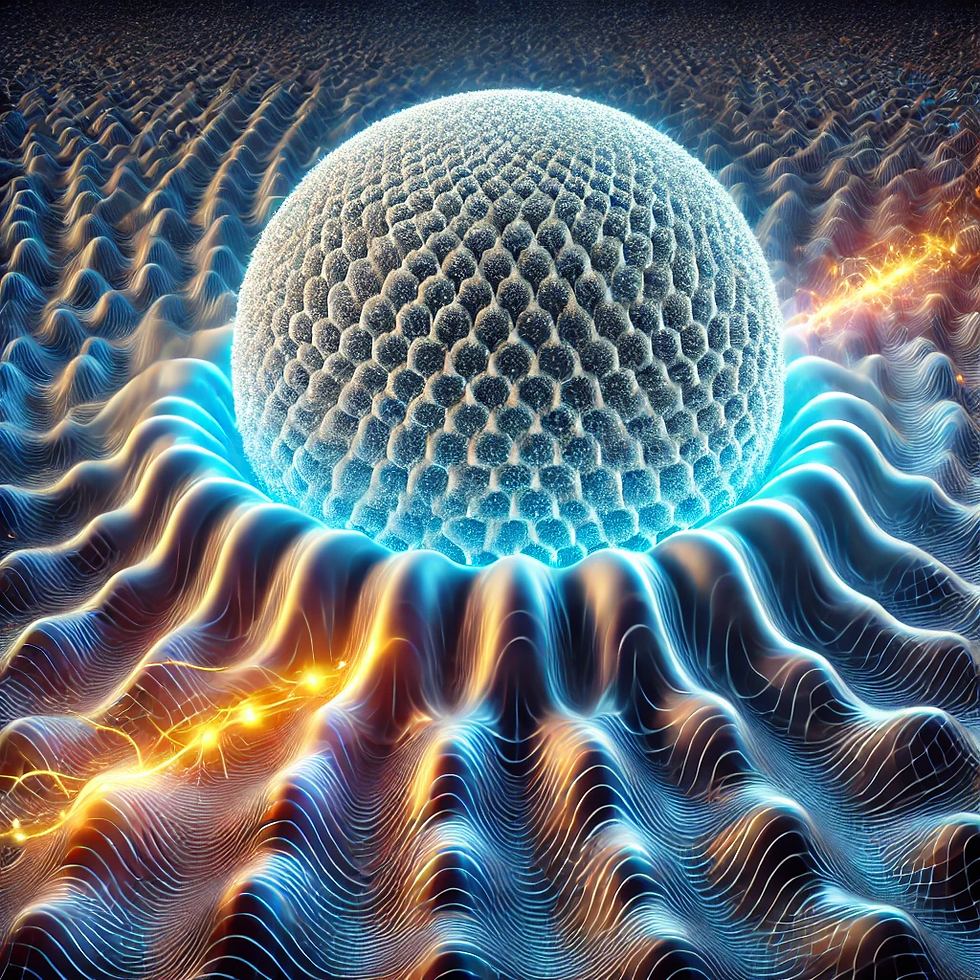
Imagine attempting to project a stable image on a TV screen that is constantly flickering with static. The image might hold, but what if the pixels could influence the image. Similarly, the coherent patterns within quantum fields—much like ripples on a dynamic ocean—may subtly be shaped and shifted by the quantum foam’s fluctuations. In this way, quantum foam may introduce a layer of influence to the dance of particles and waves.
While these ideas remain speculative, they inspire a deeper contemplation of how this dynamic interaction might influence the nature of reality. Could quantum foam serve as a gateway for the flow of information or influence between the observable and the unobservable? These questions remain tantalizingly open, awaiting further exploration.
Speculative Analogies: Bridging Science and Metaphysics
In many spiritual traditions, there is a belief in the oneness of all things—the idea that, at the most fundamental level, everything is interconnected and inseparable. The dance of quantum fields could be seen as a scientific reflection of this spiritual truth. Just as particles are not independent entities but manifestations of a unified field, perhaps all of reality is similarly interconnected. Our perception of separateness may be an illusion, much like the illusion of movement on a screen.
Here, an intriguing question arises: if quantum foam is the monitor in this analogy, with quantum fields and particles as the images projected on that monitor, then where is the processor—the unseen force computing the movement of the images on the screen? In the context of a TV, the processor governs the patterns and dynamics we see. But in the case of the universe, there is no physical, measurable evidence of a processor in the observable physical universe.
Yet, we do know that there are forces at play that we cannot explain or observe. Phenomena like dark matter and dark energy, which make up the majority of the universe, remain mysterious to us. They exert real influence on the cosmos, yet are invisible and undetectable by our current instruments. So, while we lack direct evidence for a cosmic “processor,” the presence of unmeasurable forces like dark matter and dark energy suggests that there are aspects of the universe we cannot observe—at least not with our current understanding.
The question, then, rings loudly: if this analogy holds true, where is the processor that orchestrates the dance of quantum fields and particles on the cosmic screen? Is it a hidden aspect of the universe, beyond the reach of our physical senses and instruments? Could this processor represent a deeper layer of reality—perhaps even the bridge between the physical and metaphysical realms?
In this speculative view, the universe is a cosmic symphony where quantum fields are the music, quantum foam is the media upon which the music travels, and the elusive processor—the source of all this orchestration—remains hidden, perhaps dwelling in dimensions or realities beyond our current comprehension and ability to access. This metaphor offers a way to bridge science and spirituality, suggesting that the universe is not just a cold, mechanical system but a living, dynamic process, filled with meaning and purpose. And at the core of it all, the question remains: what is the source of the dance? Where is the processor computing the cosmic symphony?
Conclusion: From Movement to Meaning
By understanding movement as an emergent phenomenon of quantum fields interacting with the underlying quantum foam, we begin to see the universe not as a static, mechanical structure but as a dynamic, ever-evolving dance. Each particle, each wave, is a step in this cosmic choreography, directed not by its own will but by the deeper forces of the fields and foam beneath it.
This new perspective raises profound questions. If movement and change are the result of field interactions, what does that say about the nature of reality itself? Are the patterns we observe in the universe—both at the quantum and cosmic scales—part of a greater, unified process? And if so, what is our role in this dance?
In the next few chapters, before we begin answering these questions, we’ll take a moment to understand the scale of the phenomena we are discussing. The smallest measurable unit of this cosmic dance: the Planck length. Likened here to the individual pixels on the screen of reality, the Planck length represents the boundary between the known and the unknown, the point at which our understanding of the universe begins to unravel. Join us as we dive into “Planck Length: The Pixelated Boundary of Reality.”
Disclaimer: Speculation at the Edge of Science and Beyond
The vastness of existence extends beyond what is knowable, beyond what is measurable, and far beyond what can be measured with current human technology—inviting us to explore realms that transcend our immediate tools and understanding.
This article explores speculative concepts inspired by scientific ideas, like quantum foam, to invite readers into a deeper reflection on the boundaries of knowledge and the possibilities that lie beyond them. While grounded in established scientific principles where relevant, the focus here is not on what science can measure or prove, but on what might exist at and beyond the edges of the known and knowable.
Science and Its Limits:
Science is among humanity’s most powerful tools for understanding the physical universe, built upon what can be measured, observed, and tested. However, concepts like quantum foam, due to their scale and nature, are beyond our current and foreseeable ability to measure or directly observe. This does not diminish their value as a framework for philosophical or metaphysical reflection. To assume that science is the sole tool for understanding reality is to imply that only the measurable and knowable can exist—a perspective that overlooks the vast opportunities for broader, more imaginative exploration.
Philosophizing Beyond Measurement:
Where science encounters limits, human thought can venture further. Beyond the measurable lies a vast expanse of possibilities that invites us to dream, speculate, and contemplate. These articles lean into the metaphysical, embracing the “what if?” to envision realities that are beyond the reach of our current scientific tools. They encourage readers to consider what might lie beyond the veil of the physical, measurable universe.
A Creative and Metaphysical Exploration:
The purpose of this article is not to assert scientific truths or definitive conclusions but to step beyond the edges of the known, where curiosity meets imagination. It invites readers to dream freely and think unconstrained by the limits of current knowledge, to see the metaphysical as a complement to the scientific—not as a replacement but as another dimension of understanding.
Distinguishing Science from Speculation:
While the ideas presented here draw inspiration from scientific theories, they are firmly speculative and philosophical in nature. They aim to inspire curiosity and contemplation rather than to claim factual accuracy. Readers are encouraged to approach this work as a thought experiment and to distinguish between the speculative reflections herein and the rigorous demands of peer-reviewed science.
An Invitation to Dream:
This article celebrates the interplay between science and imagination, stepping beyond measurement into the realm of possibility. It reflects the belief that there is value in exploring the edges of the physical and metaphysical, where the boundaries blur, and we are free to ask, “What if?”
By venturing into the possible, we honor the limits of our current knowledge while embracing the vastness of what remains unknown and even unknowable. In this way, these explorations are not just about understanding the universe but also about expanding our capacity to dream, imagine, and grow.


Comments