Masculine Feminine Integration: Beyond Polarities, There is a Third Way - a Man’s Journey

Updated: Jan 15, 2025
“True Masculine Spirituality embraces the yin and yang, the sacred male and sacred female energies. At some point in our early development, we have to leave our mothers in order to find and cultivate our male energy. We are sucked up into what our culture tells us it means to be a man, and we suppress our female energy. We are out of balance, and it is here that our inner struggle begins.” — Clay Boykin
In today’s society, men often grapple with a narrow definition of masculinity imposed by cultural conditioning. This definition emphasizes certain traits while dismissing others, leading to an internal imbalance. The journey to true masculine spirituality involves recognizing and integrating both masculine and feminine energies within ourselves to achieve wholeness.
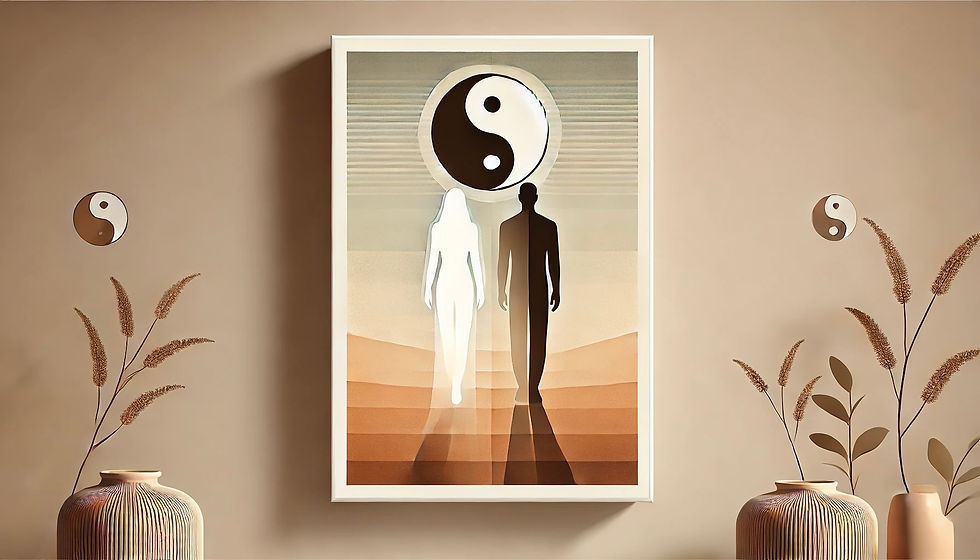
As children, we begin life deeply connected to the feminine through our mothers. This bond provides essential nurturing and grounding during our early development. However, to cultivate our own masculine essence, there comes a time when we must step away from this initial connection. This necessary separation allows us to find and develop our male energy, stepping into our individuality and personal power.
In the process of separating from the feminine, we often fall into the trap of cultural conditioning—a narrow definition of masculinity that dismisses and suppresses qualities culturally attributed to the feminine such as intuition, creativity, and emotional literacy. Society’s expectations lead us to undervalue these nurturing and emotionally aware aspects, pushing us to associate vulnerability with weakness.
A powerful illustration of how these rigid expectations shape boys from an early age can be found in the documentary The Mask You Live In, available on YouTube, which shows how many young men learn to mask their true feelings, resulting in deep shame around emotional expression (It’s worth noting that this documentary can be quite direct and potentially triggering, whether you watch it as a man, a parent, or someone who cares about the men in your life).
Consequently, irritability and anger often arise as default responses in men—reactions rooted in unconscious conditioning absorbed since childhood. Striving to meet these external ideals, we sever ourselves from important parts of our being, creating an internal imbalance that becomes the root of our inner struggles.
In an ideal world, as described in Love and Awakening, by John Welwood, parents and elders would model and transmit the integration of masculine and feminine energies. Parents would demonstrate how to balance these qualities, providing a template for children to emulate. Mothers would embody spaciousness, nourishment, and trust, fostering the child’s ability to receive and relate. Fathers would provide vision and guidance, tempered by receptivity and understanding. Together, they would demonstrate integration of both polarities within themselves and offer children a framework of values, a sense of protection, and the ability to engage confidently and curiously with the world.
In a healthy society, the interplay between men and women is celebrated, showing how masculine and feminine energies work together for the greater good.
Yet, for many men, this balance remains elusive. By midlife, many have poured their energy into external accomplishments—career, success, wealth, family—only to find themselves feeling hollow and unfulfilled. Achievements fail to fill an internal void, and a sense of hollowness emerges despite outward success. This midlife crisis arises from the soul’s unmet longing for deeper joy, meaning, and connection. The lack of integration leads to a spiritual and emotional crisis.
Related article: Meeting Kali: Why Men Are Drawn to Women Like Moths to a Flame, Again and Again—And How Embracing the Divine Feminine Leads to Transformation
Reconnecting with the sacred feminine within and allowing it to harmoniously meld with the sacred masculine offers a path to fulfillment and inner peace. This journey is not just a personal transformation but an invitation to reshape the world by modeling the balance we long for.
Our purpose in this journey is to acknowledge, explore, and accept the archetypal divine feminine energy within each of us and reconcile it with our divine masculine. This inner union, called the sacred marriage, unlocks the fullness of our spiritual essence—a wholeness that transcends the limitations of societal roles and expectations.
From a Jungian perspective, this involves integrating the anima (inner feminine) and animus (inner masculine). These archetypes represent the yin and yang energies within all individuals. They are not opposites but complementary forces within our psyche that must come into balance. Integrating these energies is a key step on the path of individuation—the lifelong process of discovering our true selves.
Carl Jung’s concepts of the anima and animus represent the feminine and masculine principles within us all. The anima embodies the receptive, nurturing, and relational aspects of the psyche—the emotional depth, creativity, and intuition. It faces our inner world and governs how we engage with our emotions and the broader, subjective world. The animus represents the active, logical, and goal-oriented aspects—the clarity, logical thinking, and action. It faces the external world and drives our engagement with goals, projects, and relationships, giving us the energy and focus to act in the material realm.
We all have an anima and an animus and their qualities are not reserved to a particular gender. These archetypes symbolize the yin and yang energies we carry, forming a polarity we must navigate. Integration occurs when we bring both energies to consciousness, creating a balanced and whole personality. This integration leads to a harmonious balance of action and receptivity, logic and intuition, individuality and connection.
One famous character who demonstrates the integration of masculine and feminine energies is Aragorn from The Lord of the Rings by J.R.R. Tolkien.
Aragorn embodies the traditional masculine qualities of strength, leadership, and action, fulfilling his role as a warrior and king. However, his character is equally defined by compassion, emotional depth, and an intuitive connection to others—traits often associated with the feminine.
For example:
Masculine Energy: Aragorn confidently takes charge in battles, leads the Fellowship, and shoulders the burden of reclaiming the throne of Gondor. He exemplifies courage, decisiveness, and a commitment to his responsibilities.
Feminine Energy: Aragorn also demonstrates deep empathy and humility. He listens to others, values relationships (such as his enduring love for Arwen and friendship with the Fellowship), and honors the wisdom of nature and the elves. His connection to healing—both literal and metaphorical—further reflects the nurturing side of his character, exemplified in the line, “The hands of the king are the hands of a healer.”
Aragorn’s ability to balance these energies makes him a fully integrated individual, a true leader who inspires loyalty and fosters harmony in a world fractured by conflict. His journey exemplifies the hero’s path of integrating polarities to achieve wholeness.
Many men fail to realize that their journey involves more than establishing a separate identity from women. There’s a deeper process requiring us to revisit and reconcile our connection with the feminine. Psychologist Lillian Rubin explains that maleness begins in a state of oneness with femaleness. The male fetus starts its development as female until the male chromosome activates, initiating the transformation of male organs. Even after birth, the male infant remains bonded to his mother, relying on her as his primary ground of existence.
The stages of male development can be outlined as follows:
Stage 1: Unity with the Feminine - Early life is marked by an unconscious fusion with the feminine. This stage provides essential nurturing and grounding but must eventually give way to individuation.
Stage 2: Separation and Differentiation - To develop his masculine energy, a boy must separate from his mother and define himself as distinct. Without guidance, this separation can harden into hyper-masculinity or lead to unresolved dependencies.
Stage 3: Return to Integration - True adulthood calls for a man to revisit the feminine, not in unconscious fusion or reactive rejection, but in conscious communion. This return completes the circle, fostering balance and emotional maturity.
Many men remain trapped in one of the first two stages. Some are psychically tied to their mother, struggling to form independent identities. They often remain emotionally immature, treating relationships as extensions of their childhood needs. Others reject the feminine entirely, adopting a rigidly macho persona to guard against the fear of being “engulfed” by what once felt all-encompassing. They may act out of unconscious reactivity, viewing the feminine with distrust and keeping their emotional world tightly controlled. The dog-eat dog world they try to protect themselves from is a projection of their reactive approach to masculinity and their distrust of the feminine.
In both cases, men are driven by fear—either of dependence or vulnerability—and remain disconnected from their full potential, unable to cultivate healthy, intimate relationships.
Our culture often celebrates the second stage of male development, equating masculinity with conquest and independence. Young men are encouraged to break away, assert independence, and achieve dominance in their respective fields.
Cultural misconceptions prize endless ascent and conquest, overlooking the importance of inner growth. True strength involves facing our fears and emotions, embracing vulnerability as a pathway to deeper connections. Healing the fear of the feminine involves recognizing the feminine as an ally, not a threat, and committing to inner work.
Embracing vulnerability enhances authenticity and relationships.
However, true heroism lies not in endless ascent but in the courage to return—to delve into oneself and embrace vulnerability.
Men’s fear of women often mirrors a deeper distrust of their own receptive side—the yin within. This fear leads to guardedness in relationships and a misconception of strength.
To understand why some men may fear women, it’s essential to look beyond the surface of interpersonal dynamics and into the internal struggles men often face with their own emotions and vulnerabilities. From an early age, many men are conditioned to view emotional openness, receptivity, and intuition—the yin, or traditionally feminine, qualities within themselves—as signs of weakness. This societal programming creates a disconnect from their own inner softness, leading to discomfort or even fear when they encounter those same qualities externally, particularly in women. In this way, men’s fear of women is often less about women themselves and more about what women may reflect back to them: a part of their inner world they have been taught to reject or suppress.
To heal this fear, we must:
1. Recognize the Feminine as an Ally - Understand that embracing the feminine brings balance. The feminine energy is the life force that offers renewal and connection.
2. Embrace Vulnerability - Strength lies in the courage to express emotions. Vulnerability enhances authenticity and relationships.
3. Commit to Inner Work - Use relationships as opportunities for personal growth. Address areas where integration is needed.
Life moves in rhythmic pulses, flowing between opposing forces. The masculine, active (yang) embodies expansion, individuation, and outward action, while the feminine, receptive (yin) expresses grounding, cohesion, and inward reflection. Together, they create the pulsation of life—an endless cycle of forming and dissolving, intensifying and releasing. The yin nature is the foundation for life—the water that nourishes, the egg in the womb, the receptive space from which all creativity and action emerge. Without access to this grounding energy, our outer actions lack substance and connection.
Authentic power emerges from the union of the masculine and feminine, like two streams converging into a mighty river. Disconnected power manifests as domination, exploitation, and destruction. This toxic expression of yang—seen in our culture’s obsession with control—lacks the balance and reverence necessary for genuine authority. True power flows from aligning with life’s rhythms. Surrendering to this flow enhances creativity and connection.
Integration is the path to wholeness. Jung emphasized the importance of integrating the anima and animus as part of the individuation process—the journey toward self-realization.
This involves recognizing and withdrawing projections, claiming these qualities as internal rather than external, and balancing the inner masculine and feminine.
Projections occur when we unconsciously attribute our own unacknowledged traits—whether positive or negative—onto others, seeing in them what we cannot yet see or accept in ourselves.
For example, a man might project his own capacity for nurturing and emotional sensitivity onto women, believing these traits are “feminine” and unavailable to him. Similarly, a woman might project her inner assertiveness or decisiveness onto men, assuming those traits are inherently “masculine” and not part of her own nature. By identifying and reclaiming these projected qualities, we take responsibility for our inner dynamics, fostering greater self-awareness and integration.
The steps to integration include:
1. Awareness - Recognize patterns of projection in relationships. Understand how they reveal unconscious dynamics.
2. Reflection - Explore emotions, dreams, and fantasies. Uncover the workings of the anima and animus.
3. Ownership - Accept these qualities as parts of yourself. Move beyond attributing them to others.
4. Expression - Cultivate the positive aspects in daily life. Embrace empathy, creativity, clarity, and confidence.
The inner marriage transcends binary thinking. It fosters a balance of action and receptivity, logic and intuition. Integrating these archetypes leads to authenticity and wholeness.
A new vision of masculinity involves redefining strength and embracing wholeness. Balanced relationships are based on mutual growth, support, celebrating and integrating both masculine and feminine energies. Strength is redefined as the courage to be whole and vulnerable, moving beyond dominance and stoicism. By embracing both energies, we realize our full potential and become partners, leaders, and creators who embody the full spectrum of human capabilities.
The journey of masculine development is one of heroic integration. In a nod to Joseph Campbell’s hero’s journey, it begins with separation but must lead back to connection—with the feminine within and within others. The hero’s journey framework mirrors the process of individuation: a departure from the familiar, an encounter with trials and inner truths, and a transformative return to wholeness. This requires the bravery to confront fears and embrace transformation.
By integrating masculine and feminine energies, we reclaim our wholeness, leading to meaningful, balanced relationships. Modeling this balance can reshape the world, as we become individuals who embody the potential for harmony, integration, and genuine connection.
Let us embark on this path together, exploring what it means to live fully in harmony with ourselves and others. By integrating the sacred masculine and feminine within, we can reshape our lives and the world around us. Embracing true masculine spirituality through the integration of our inner energies opens the door to a more fulfilling and authentic existence. This journey requires courage, self-reflection, and a willingness to challenge societal norms. Together, we can foster a new vision of masculinity that honors the wholeness of our being.
Further Resources:
The Mask You Live In - A powerful illustration of how rigid expectations shape boys from an early age can be found in the documentary The Mask You Live In, available on YouTube, which shows how many young men learn to mask their true feelings, resulting in deep shame around emotional expression (It’s worth noting that this documentary can be quite direct and potentially triggering, whether you watch it as a man, a parent, or someone who cares about the men in your life).
King Warrior Magician Lover - A symbolic framework that illuminates this process can be found in Robert Moore and Douglas Gillette’s King, Warrior, Magician, Lover. Their work delves into four core masculine archetypes (and their shadows), offering a powerful lens and language for understanding the full range of masculine dynamics and behaviors. The example of Aragorn mentioned above represents the balanced king archetype. For those seeking an introduction, this video playlist provides vivid imagery and insightful commentary on these archetypes.
Men’s Groups - Many men find it difficult to build genuine friendships with other men while sharing more openly with the women in their lives, whether those are partners, relatives, or therapists. Yet certain issues, such as exploring one’s relationship with a father, navigating personal identity, or understanding dynamics with women, can benefit from perspectives found only among fellow men. Participation in men’s groups reveals the extent to which men are frequently isolated, shaped by societal expectations and burdened by emotional wounds they may not fully acknowledge. Attending a men’s group often dispels the notion that anyone is fundamentally different from others; testimony after testimony—whether it concerns alcoholism, infidelity, or more universal experiences—can spark a profound sense of recognition and connection. This underscores the principle that the work of one man resonates with all, reflecting how stories become powerful tools for growth. Behind every “mask” lies a sensitive soul, and men’s groups bring together those willing to remove that mask for the benefit of everyone present. An article from Harper’s Bazaar offers an introduction to some of these reflections, albeit in a simplified manner. It nonetheless serves as a helpful entry point for understanding the complexities of modern masculinity and the unique challenges men face in forming authentic, supportive relationships.
Yvette Martin Browne: A Woman’s Perspective on Masculine-Feminine Integration: I write about masculine feminine integration from a men’s perspective but I would encourage you to explore the work Yvette Martin Browne for a powerful, woman-centered take on masculine-feminine integration, Yvette Martin Browne’s “Unleashing Your Inner Strength: Embracing Masculine Energies with Confidence and Conviction” is an excellent read. Browne shows how women can harness qualities like assertiveness, structure, and clarity without sacrificing empathy or intuition. By offering practical guidance—everything from goal-setting to healthy boundary formation—her article complements a men’s-focused lens, giving women a female voice to illuminate the path toward balanced self-empowerment. You can explore her website “The Great Enlightenment” for more content on related themes and her Tips for Enlightenments book series.
John Welwood: Love and Awakening
For deeper insight into masculine psychological development—particularly the idea of three developmental stages—John Welwood’s Love and Awakening: Discovering the Sacred Path of Intimate Relationship offers a thoughtful exploration of how spirituality and intimacy intersect. Welwood provides a framework that helps contextualize the evolution from early separation to a more mature, integrated masculinity.
Murray Stein: Jung’s Map of the Soul
For an in-depth look at Carl Jung’s foundational concepts, including the anima and animus, Murray Stein’s Jung’s Map of the Soul is an accessible guide to Jungian thought. Stein breaks down the psyche’s structure in clear terms, illustrating how integrating these internal masculine and feminine aspects can lead to greater self-awareness and harmony.

Comments